Probability is one of the main reasons casinos can maintain a mathematical advantage over time. Casino games are designed so that the chances of different outcomes and the payouts attached to those outcomes work together in a way that gives the house an expected advantage.
This does not mean the casino wins every game or every day. Individual results can be completely different from the long-term mathematical expectation.
Probability and Payouts Work Together
To understand the casino advantage, it helps to look at two things:
- How likely an outcome is
- How much that outcome pays
A casino game can offer a large payout for an outcome that is difficult to achieve. At the same time, more common outcomes may have smaller payouts.
When all possible outcomes are considered together, the game’s mathematical average can give the casino an advantage.
A Simple Example
Imagine a very simple game with two possible outcomes:
- 50% chance of winning $1
- 50% chance of losing $1
In this example, the expected value is zero because the two possibilities balance each other.
Now imagine the game changes so that the player still has a 50% chance of winning, but the winning payout is only $0.90 for every $1 wagered.
The player now receives:
50% × $0.90 = $0.45
The expected loss from the losing half is:
50% × $1 = $0.50
The overall expected result is:
$0.45 − $0.50 = −$0.05
The game now has a mathematical advantage of 5% for the house.
Roulette Shows the Idea Clearly
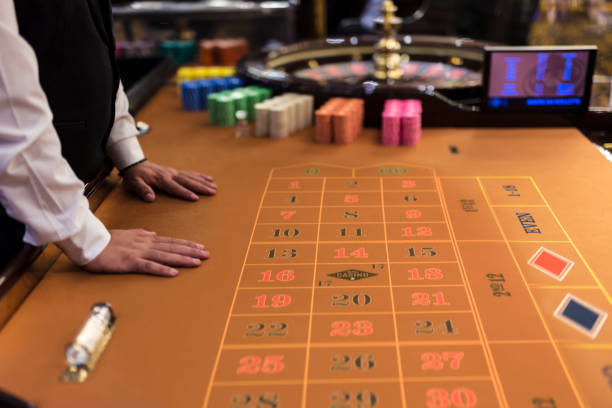
European roulette provides a real-world example.
There are 37 pockets on the wheel, but a straight-up bet on a number pays 35 to 1.
If the game had 36 equally likely numbers and paid 36 to 1, the mathematical relationship would be different.
The extra zero creates a situation where the probability of winning is slightly lower than the payout structure would need for a completely fair game.
This produces a house edge of approximately 2.70% on standard roulette bets.
The Role of RTP
Return to Player (RTP) is another way of describing the mathematical relationship.
If a game has a theoretical RTP of 96%, its corresponding house edge is approximately 4%.
This means that over a very large amount of play, the mathematical model is expected to return about 96% of wagers as winnings, leaving an expected 4% difference for the house.
The UK Gambling Commission explains that actual RTP can vary from theoretical RTP because of normal statistical variation, particularly over smaller samples.
Individual Results Can Be Very Different
A house edge does not mean that every player loses the same percentage.
Suppose someone plays a game with a 4% house edge.
One player might win $500. Another might lose $100. A third player might finish close to break-even.
All of these results can occur within a game that has a 4% theoretical house edge.
The advantage becomes meaningful when the game is played repeatedly across a very large number of wagers.
Probability Does Not Make Results Predictable
Knowing the probability of an outcome does not tell us exactly when it will happen.
For example, a particular number on a European roulette wheel has a probability of about 2.70% on each spin.
It could appear twice in a row or fail to appear for many spins.
The mathematical probability remains the same for each independent spin.
This is why a casino’s advantage should not be confused with certainty.
Why Casinos Use Different Payouts
Different payouts allow casino games to offer many types of bets and prizes while maintaining a mathematical structure that favors the house.
A rare event can have a large payout, while a common event can have a smaller payout.
The game designer calculates the probabilities and payouts together to determine the overall expected return.
This applies to table games, slot machines, lottery-style games and many other forms of gambling.
Probability, Expected Value and House Edge
These three concepts are closely connected:
Probability tells us how likely an outcome is.
Expected value combines probability with the value of each possible outcome.
House edge describes the casino’s mathematical advantage in the resulting game.
Understanding these relationships explains why a casino can offer players the possibility of large wins while still having a positive long-term mathematical expectation.
The Bigger Picture
The casino advantage is not created because the casino can predict every individual result. It comes from the mathematical design of the game.
Probabilities, payouts and rules are combined so that the expected result favors the house over a large number of wagers.
Short-term results can move far away from that expectation, but probability and statistics explain why the advantage becomes more reliable as the number of games and wagers increases.