
House edge is the mathematical advantage that a casino has in a game over a large number of bets. It is one of the most important ideas in casino mathematics because it helps explain how casinos can make money even though individual players can win.
House edge is normally shown as a percentage. A lower percentage means a smaller mathematical advantage for the casino, while a higher percentage means a larger advantage.
A Simple Example
Suppose a casino game has a 4% house edge.
In simple terms, this means that over a very large number of bets, the casino has a mathematical expectation of keeping about $4 for every $100 wagered.
This does not mean the casino will win exactly $4 from every $100.
A player could win $100 on one bet or lose $100 on another. House edge describes the expected result across a large number of bets.
House Edge and RTP
House edge is closely connected to Return to Player (RTP).
RTP tells us the theoretical percentage of wagers that a game is designed to return to players over a very large number of plays.
The basic relationship is:
House Edge = 100% − RTP
For example:
| RTP | House Edge |
| 95% | 5% |
| 96% | 4% |
| 97% | 3% |
| 98% | 2% |
So, a game with a theoretical RTP of 96% has a theoretical house edge of 4%.
The UK Gambling Commission explains that RTP is an average calculated over a large number of games and should not be treated as a guarantee for an individual playing session.
House Edge in Roulette
Roulette provides a simple example of house edge.
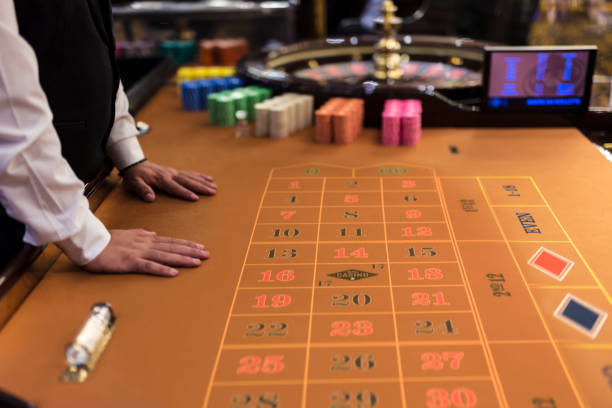
A European roulette wheel has 37 pockets: numbers 1 through 36 and one zero.
If you bet on one specific number, there is one winning number out of 37. However, the payout for that winning bet is based on 35-to-1 odds rather than 36-to-1.
That difference gives the casino a mathematical advantage of approximately 2.70% on standard bets.
American roulette has both 0 and 00, giving it 38 pockets. This increases the standard house edge to approximately 5.26%.
The difference shows how a small change in game design can significantly affect the mathematics.
House Edge in Blackjack
Blackjack is more complicated.
Unlike roulette, players make decisions during a blackjack hand. Whether a player chooses to hit, stand, split or double can affect the mathematical result.
The house edge also depends on the specific table rules, such as the number of decks, dealer rules and blackjack payout.
Therefore, there is no single house-edge percentage that applies to every blackjack game.
House Edge Can Differ Within One Game
A single casino game can have several different betting options with different house edges.
Baccarat is a good example.
The standard Banker bet generally has a lower house edge than the Player bet, while the Tie bet has a much higher house edge.
This means it is not always enough to ask, “What is the house edge of this game?” The specific bet and rules also matter.
Does House Edge Guarantee a Casino Win?
No.
House edge describes a long-term mathematical expectation, not a guarantee.
A casino can lose money during a particular period if players experience unusually successful results. Likewise, an individual player can win despite playing a game with a house edge.
Random outcomes can produce significant short-term differences from mathematical expectations.
Why Does the Casino Have an Edge?
The house edge is usually created by the relationship between probability and payout.
A casino game may offer a payout that appears attractive, but the probability of receiving that payout is taken into account when the game is designed.
The combined value of all possible outcomes produces the game’s expected mathematical return.
Why House Edge Matters in Casino Mathematics
House edge helps explain one of the most basic principles of casino games: the game can be designed so that the casino has a mathematical advantage over time.
It does not predict the next result and does not determine who will win an individual bet.
Instead, it is a statistical measure of the game’s long-term structure. Understanding house edge makes it easier to understand RTP, expected value, probability and other important concepts in casino mathematics.