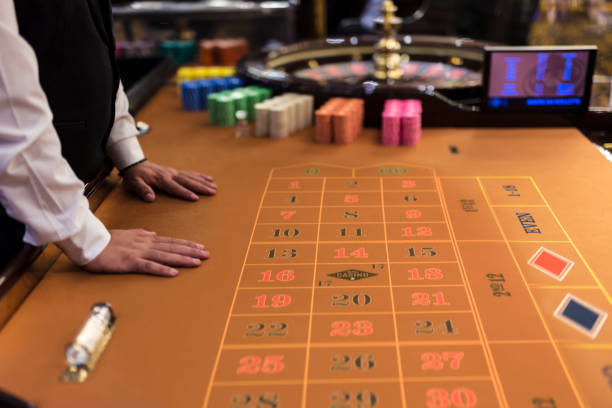

Casino games are built around numbers, and probability statistics help explain those numbers in a simple, measurable way. They can tell us how likely an outcome is, how often certain results are expected to occur and how the mathematical advantage of a casino is created.
Statistics do not tell us exactly what will happen on the next spin, roll or hand. Instead, they help us understand what can be expected when a game is played many times.
What Is Probability?
Probability means the chance that something will happen.
It is usually shown as a percentage, fraction or decimal.
For example, if an event has 1 chance out of 10 of happening, its probability is:
1 ÷ 10 = 10%
Casino games use probability to describe possible outcomes.
In European roulette, for example, there are 37 pockets. A straight-up bet on one particular number therefore has a probability of:
1 ÷ 37 ≈ 2.70%
What Is Frequency?
Probability describes the chance of an event, while frequency describes how often an event actually happens in a set of results.
Imagine a roulette number appears 8 times during 300 spins.
Its actual frequency is:
8 ÷ 300 × 100 ≈ 2.67%
The theoretical probability of that number appearing is about 2.70%.
The two numbers are very close in this example, but they do not have to match in a smaller sample.
Theoretical vs. Actual Results
Casino mathematics often separates theoretical statistics from actual statistics.
Theoretical probability comes from the rules of the game.
Actual results come from what really happened during a particular period.
For example, a fair coin has a theoretical probability of 50% for heads. But if you toss it 10 times, you might get heads 7 times.
That does not mean the probability has changed. It simply shows that smaller samples can produce different results.
Casino games work in a similar way.
What Is RTP?
Return to Player (RTP) is another important casino statistic.
RTP represents the theoretical percentage of wagers that a game is designed to return over a very large number of plays.
For example, a game with a theoretical RTP of 96% has a mathematical expectation of returning about $96 for every $100 wagered over a sufficiently large sample.
The UK Gambling Commission explains that actual RTP can vary from the theoretical RTP, especially over shorter periods.
What Is House Edge?
The house edge represents the casino’s mathematical advantage.
A simplified calculation is:
House Edge = 100% − RTP
Therefore, a game with a 96% theoretical RTP has a 4% theoretical house edge.
This does not mean that every player loses exactly 4% of their money. Individual results can be completely different.
What Is Volatility?
Volatility describes how widely game results can vary.
A high-volatility game may produce larger wins less often, while a low-volatility game may produce smaller wins more frequently.
The UK Gambling Commission explains that volatility relates to the distribution of prizes and can be measured statistically using methods such as standard deviation.
This is important because two games with the same RTP can have very different patterns of results.
Why Sample Size Matters
One of the most important ideas in casino statistics is sample size.
A small number of results can be heavily influenced by random variation.
For example, a slot with a theoretical RTP of 96% might produce an actual RTP of 85% during one short period and 105% during another.
These differences do not necessarily mean the game’s underlying mathematics changed.
When a much larger number of plays is measured, random fluctuations generally have less influence on the overall average.
What Statistics Cannot Tell Us
Casino statistics can describe mathematical patterns, but they cannot guarantee a particular result.
Knowing that a roulette number has appeared several times does not mean it is more or less likely to appear on the next spin.
Likewise, knowing a slot’s RTP does not tell you whether the next spin will win.
Statistics describe long-term patterns, not individual outcomes.
Why Casino Probability Statistics Matter
Probability statistics provide the foundation for understanding casino mathematics.
They help explain:
- How likely outcomes are
- How frequently results occur
- How RTP works
- How house edge is calculated
- Why short-term results can vary
- How volatility affects the spread of results
Once these concepts are understood, casino games become easier to analyze mathematically. Instead of looking only at wins and losses, statistics allow us to examine the probabilities and patterns behind those results.